



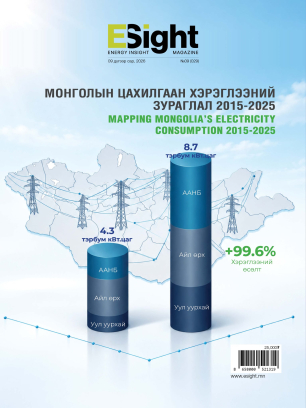


Mapping Mongolia’s electricity consumption 2015-2025
What Electricity Consumption Reveals About Development
Energy Insight presents readers with an important set of figures: Mongolia’s electricity consumption between 2015 and 2025.
Compared with news about new power plants and additional generation capacity, consumption statistics may attract less attention. Yet if we continue to look at energy only from the supply side, we risk overlooking an important question: what kind of economy, production and way of life is Mongolia using its energy to support? The structure of energy consumption offers a starting point for answering that question and understanding the direction of the country’s development.
To explore this, we approached the Energy Regulatory Commission. We would like to thank B. Bolor-Erdene, Head of the ERC Secretariat, for responding to our request and providing electricity consumption data for 2015-2025, divided into three main consumer groups: households, mining, and other businesses and organizations.
The figures from the past decade reveal not only growth in the energy sector, but also broader economic trends. Mongolia’s electricity consumption has almost doubled. What has driven this growth? Industry, services, or changes in household life?
B. Bayanjavzan’s article, based on data for 2015-2025, shows that household consumption has grown the fastest. The number of electricity consumers living in apartments has increased, while the share of household use in total consumption has also expanded. This reflects changes in living conditions and everyday household needs. But to what extent has industrial development kept pace with this change?
Of course, these three broad categories are not sufficient to fully explain changes in industry and services. Mining, a major electricity-consuming sector, has increased its consumption, while its share of total consumption has declined. It would be too simplistic to interpret this as evidence of slower growth in the sector. There are many other factors to consider, including self-generation, electricity imports through dedicated lines and grid constraints. That is a subject for another article.
Another telling figure is that electricity imports are now roughly equivalent to total household consumption. If imports continue to grow alongside demand, this dependence will continue to affect the benefits of new development projects, the reliability of industrial operations and even households’ daily lives.
One more figure deserves attention: pending applications for new grid connections total 2,266 MW. The fact that this level of demand remains unconnected to the grid is itself an important indication of development potential.
All of this raises the next question for energy policy: where should new capacity be built, who should receive it, and in what order? The reason we are presenting this picture of consumption is to help readers see both what Mongolia has built through the growth in demand over the past decade, and what it could build from the demand now waiting to be connected. Deciding who gets connected first is, in effect, deciding which industries, development projects and forms of development Mongolia chooses to prioritize.

 2026-10-13


