



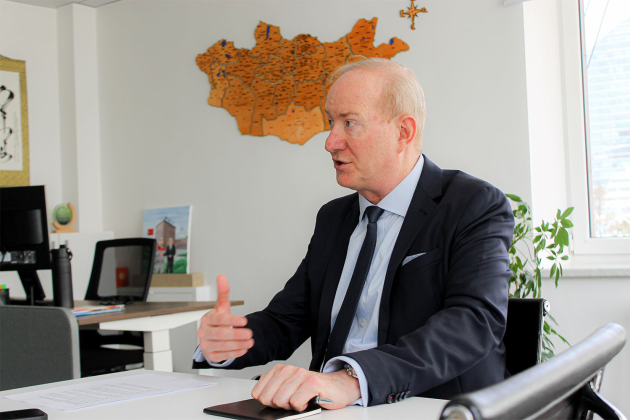


Interview with Mr. Hannes Takacs Head of EBRD Mongolia, European Bank for Reconstruction and Development (EBRD) Interview by N. Sukhbat, Executive Director of Energy Insight Magazine.
Could you please tell us about yourself, and the work European Bank of Reconstruction and Development does in Mongolia?
I arrived in Mongolia during the COVID-19 pandemic in 2020. My start here was quite interesting, as it was a very challenging time for the country and its population. At that time, electricity suddenly became free of charge. This drastically changed consumption patterns-since energy didn’t cost anything, consumption patterns changed. Reversing those patterns after reintroducing or increasing tariffs proved to be very complicated. It’s important that everyone understands energy has a cost. The more energy-efficient your lifestyle and home are, the better it is-not only for the country, but for yourself. The European Bank for Reconstruction and Development (EBRD) launched its Green Economic Transition Initiative in 2006. Our current institutional strategy focuses on being a green bank, with 50% of our investments directed toward green projects. We have a dedicated unit within the Bank that monitors our activities and verifies the green impact of every project. Every project funded by us must meet at least two transition qualities that contribute to a country’s development-one of which is being green. This means half of our investments must have a green angle. In Mongolia, we’ve exceeded this target, thanks to a growing openness among companies to explore green and energy-efficient solutions. That level of commitment is something you don’t find in many countries, but it’s different here, particularly in Ulaanbaatar. I believe this awareness is largely driven by the city’s severe air pollution. Everyone in Ulaanbaatar knows action is necessary.
The EBRD is a green investment leader in both Central Asia and Mongolia. Last year, fifty-eight per cent of our investments in the region (out of total €2.26 billion) were aimed at supporting green economy projects. That’s quite an achievement, considering the challenges companies face in implementing green solutions.
Sometimes the costs are higher, or policies must be changed to meet sustainability goals. But this is a crucial part of the process it influences corporate behavior and strategy for the better. Companies often realize, especially after electricity prices rise, that energy consumption becomes a significant item on their balance sheets. That’s when they start switching to more energy-efficient equipment, constructing green buildings, or improving their warehouses-ultimately improving company performance. This shift in mindset is critical. When something is free, it’s typically overused. But when a cost is attached, behavior changes. Here in Mongolia, we’re implementing our Green Economy Financing Facility (GEFF), which provides funding to local banks for onward lending to households and companies. These loans support projects that reduce energy consumption by at least 20%. Due to the recent increase in electricity tariffs, we’re now seeing rising demand not only from companies but also from households. This growing awareness encourages people to insulate their homes, adjust heating systems, and live in environments where indoor temperatures are more moderate-say 22 to 23°C, instead of sometimes 25 to 28°C. These changes are significant because they not only reduce overall energy consumption-improving Mongolia’s energy security and reducing the need for imports-but also help mitigate air pollution. That brings benefits to everyone in society. Ultimately, our goal is to help reduce air pollution in Mongolia. One of the reasons is the serious health impact it causes. Mongolia has a relatively high cancer rate, and in some areas, particularly the ger districts, we’ve seen serious health implications. Every improvement we can make-through renewable energy or simply by using less energy-contributes to better public health. That’s also a strong source of motivation for our team. You can really see the positive impact on many levels when the energy supply and its sources are improved.
I think we should talk about how we can measure the impact of the air pollution in the monetary values?
The Mongolians spend around $200 million to travel abroad for medical treatment which is a huge amount. If the government can reduce the health issues caused by the air pollution and at the same time upgrade the medical system, it would be beneficial for the whole country. Everything is interconnected, and that complexity is often difficult to communicate effectively to the public. This is why your work as a media outlet focusing on energy, environment, and sustainability is so important. It helps build public awareness and understanding, enabling people to grasp the core of the problem and to see it from a holistic perspective. For example, last year in our operations, we helped procure 8 GW of renewable energy in Uzbekistan and Kazakhstan. The good news is that it was done through competitive auctions, which led to prices significantly lower than what households are currently paying in those countries. This approach also means less public debt, as the financial burden on the government is reduced.
What initiatives are planned by the EBRD for the coming years?
Last year, we witnessed one of the highest levels of annual investment the EBRD has ever made in Mongolia. Nearly 58% of our investments went into green projects. In addition to the USD 264 million invested directly by us, additionally we mobilized another USD 52.4 million from co-financiers. In total, we invested over USD 310 million in Mongolia in 2024. Although Mongolia is a small country with a relatively small economy, this clearly demonstrates a strong demand for financing-and that additional resources are needed. We are working very actively with our local partner banks. Our intention is not to crowd them out of the market, but to collaborate and strengthen the financial sector together. A robust financial sector, combined with a strong energy sector, is essential-and entirely achievable.
To date, our focus has largely been on energy generation. The first wind farm project in Mongolia was financed by the EBRD, and two other privately owned wind farms in the country have also been financed by us. Including financing from our syndication partners, we have provided over USD 300 million to the renewable energy sector at a very early stage of its development. Of course, renewable energy is only one piece of the puzzle. Generating clean energy is critical, but without the ability to transmit it, that energy will never reach households. That’s why we’re currently focused on helping the government strengthen grid infrastructure especially transmission lines. One of our key projects is the upgrade of the Choir–Sainshand transmission line. Improving this line is particularly important, as the surrounding area has high potential for renewable energy production. The Sainshand wind farm and several other renewable energy facilities are located there. Additionally, the area is close to mining operations that require electricity to begin or expand their activities. Upgrading Mongolia’s transmission grid is one of the most complex undertakings, given the country’s vast geography. Extending transmission lines to every corner of Mongolia is not only extremely costly, but also time-consuming. That’s why we must consider alternative models-whether to pursue a unified national grid or develop regional mini-grids that serve individual aimags (provinces). The latter can be more cost-effective and significantly enhance energy security. Relying on energy imports from neighboring countries is both expensive and poses a strategic risk. In the long run, it’s better for Mongolia to become an energy exporter rather than an importer The EBRD is trying to help the government of Mongolia as well as the private generators to find a holistic system to make generation, transmission and export of energy easier. It’s about building an integrated value chain.
The most important foundation for all this is a supportive legal and regulatory environment. Beyond our work with companies and households, we are also implementing the GEFF in partnership with Khan Bank and XacBank. At the same time, we are providing direct financing for green projects. One of the major milestones last year was the introduction of Mongolia’s first sustainability-linked loan. Under this mechanism, a company that meets its environmental targets receives a partial refund on the interest paid. This model is attractive to companies because it offers a financial incentive-rewards are only given when the targets are achieved. This structure creates a demonstration effect: transitioning to more energy-efficient or environmentally friendly solutions doesn’t just reduce financing costs-it also benefits the environment and improves a company’s financial performance. I’m very proud of that first sustainability-linked loan, and I hope it will be the first of many. I also hope that commercial banks in Mongolia begin offering sustainability-linked loans to their clients. Households, too, can benefit from the Green Economy Financing Facility-for example, by upgrading insulation, replacing boilers, and undertaking other projects that improve energy efficiency. But meaningful change requires a shift in behavior-from policymakers to end-users, and everyone in between, including businesses. We also have the “Green City” program. In 2018, Ulaanbaatar became the first Asian city to adopt a Green City Action Plan among the EBRD’s country of operations. Some of the projects we are now implementing-together with the Ministry of Finance, and the City of Ulaanbaatar are based on that action plan. One of these involved upgrading the district heating system to reduce heat losses in the pipelines and expand capacity. It’s essential to have a clear strategy in place, as it helps define the goals and the path to achieve them.
The EBRD invested more than 260 million last year in 18 projects, majority of the which were directed towards green transition projects. What are the key features of these projects?
These projects fall under climate adaptation or climate mitigation, and they include not only technological solutions but also behavioral changes and energy efficiency which is a critical component. For example, last year we financed our first green office building, which will be EDGE certified, a globally recognized green building standard. This certification is not yet reflected in Mongolia’s building code, unfortunately. However, by providing incentives through tailored loan structures, we’re helping companies recognize the value of green certification. This office building is just the beginning. We also signed an agreement for green affordable housing, which targets the residents of ger districts. There is a myth that green housing is inherently expensive-but this simply isn’t true. It’s about finding the right solutions and designing projects properly from the outset. By doing so, we aim to deliver two strong demonstration effects: Firstly, you can build green office buildings at a reasonable and competitive cost. Secondly, you can deliver green, affordable housing-with a focus on improving the living standards of vulnerable urban populations-without making it financially inaccessible. We’re currently speaking about a project that will deliver over 700 housing units, designed to provide a realistic and sustainable alternative to current living conditions in the ger areas.
What is your position on energy sector reform announced by the Government of Mongolian? How do you think the EBRD can support this process?
We had extensive discussions with the government regarding energy transition and reform. Earlier this year, we signed a Memorandum of Understanding (MOU) in Davos, Switzerland. This MOU not only covers auctions for renewable energy and battery storage but also includes our support in drafting a high-level energy policy for the government. The aim is to establish a clear direction for the country’s energy system-making it easier for everyone to understand where the system is headed and why. This clarity will help justify the reform process and demonstrate the tangible impacts. We’re not only talking about the impact on economic growth-we’re also talking about the impact at the individual level. If a country experiences high economic growth but its citizens don’t see or feel the benefits, they will not support that growth. It’s essential that people understand what energy reform means for them personally-for their families and daily lives. Public communication must be transparent about what is planned for the energy system and the reasons behind those decisions. Relying heavily on a foreign country for energy supply is far from ideal. If a disruption occurs in their system, it becomes very difficult to quickly implement a domestic solution. Mongolia’s energy system needs reform. The country’s aging transmission grid is inefficient, with energy losses ranging from 10% to 15%. Simply upgrading the grid could increase the amount of power supplied by that same percentage-without incurring additional generation costs.
At the same time, Mongolia needs a smart network system that includes household-level monitoring with smart meters. This isn’t just about investment; it’s about technology upgrades and sequencing reforms properly. If you invest in new power generation but don’t yet have the transmission lines in place-as mentioned earlier-you run into serious bottlenecks. Transmission lines take longer to build than solar or wind plants. That understanding is now reflected in the government’s reform planning. There’s a working group on energy from the government side acting as a coordinating mechanism, and I am optimistic because we’re seeing very positive signs. Historically, energy prices in Mongolia have been too low-below the cost of production-leading to deficits for the government. While prices have since increased, it's equally important to ensure that low-income households are protected. They should continue to have access to heating and water through targeted subsidies. Meanwhile, the construction industry must be encouraged to build more energy-efficient buildings. The current trend of building quickly and cheaply benefits neither the buyers nor the long-term maintenance of those apartments. As energy costs rise, consumers will become more attentive to energy efficiency. In the long term, this will also push the construction sector to offer higher-quality, higher-value apartments at reasonable costs. One important point that’s often overlooked is that building standards can change after a purchase. If your apartment doesn’t meet newer energy standards, it may lose market value. This makes energy efficiency a form of value creation for homeowners. You could also link mortgage subsidies to energy efficiency. For instance, buyers of energy-efficient apartments could receive 100% of the available mortgage subsidy, while those purchasing less efficient homes would receive a gradually reduced rate. This would change buyer behavior and incentivize developers to focus on energy efficiency.
Through a variety of instruments-sustainability-linked loans, green loans, and bonds-we are trying to provide the right financing solutions for everyone. Households can access financing through our partner banks, while larger companies can work directly with us depending on their needs. Additionally, we’re working with non-bank financial institutions because we recognize that many microenterprises in Mongolia struggle to access loans from banks. Our goal is to cover as many target groups as possible, offering them appropriate and effective financial tools.
What should Mongolia consider when seeking international green financing?
I believe the investment climate in Mongolia will largely depend on the final version of the new Investment Law. Currently, only a draft exists, and we don’t yet know what the final law will look like. Nevertheless, private investors typically look for two key factors when considering entry into a new market. First, they seek political stability. In that regard, Mongolia is doing well. The country enjoys political stability, and there is currently a window of opportunity for reforms to advance, especially with broad coalition support. This could allow the reform agenda to move forward more quickly than in the past. Second, investors look for legal and regulatory certainty as well as proper enforcement. Mongolia generally has strong legislation in place, but enforcement is the critical next step. Laws are only effective if they are enforced consistently, transparently, and in a stable manner. Investors can tolerate a less-than-perfect legal framework if it remains consistent over time. What discourages them is frequent legal and regulatory changes, which introduce uncertainty. Uncertainty increases perceived risk, and higher risk gets priced into investment decisions. For Mongolia, which currently holds a B+ credit rating, improving legal stability and enforcement could help the country move to the next rating tier. I also see strong commitment from the government to build a reliable and sustainable energy sector. This is driven not only by the need for energy security but also by the realization that Mongolia has significant export potential. Geographically, Mongolia is ideally positioned: it has high solar radiation, strong wind resources, and hydropower potential. Geothermal energy-especially in rural areas-is another promising but underexplored opportunity. This diversity provides a solid foundation for a balanced and resilient energy mix. The key is prioritization and ensuring that power purchase agreements (PPAs) fairly reflect the cost of implementation while providing security for investors. One major concern for investors is curtailment. For example, if a solar or wind farm generates 100 MW but the grid can only absorb 20 MW, the project becomes economically unviable. Avoiding curtailment requires effective planning-both in terms of grid capacity and tariff structures. Investors need guarantees that their energy can be sold and that there is a viable offtake agreement in place. Another factor investors consider is the location of transmission infrastructure. If a renewable energy project is far from the nearest power line, the cost of connection can be prohibitively high. That’s why grid planning is so important. We’ve had very positive experience with this approach in Uzbekistan, where the EBRD has been a major supporter of energy auctions. In those auctions, we’ve seen highly competitive pricing-around 2.8 cents per kilowatt-hour. At the same time developers can build battery storage or short sections of transmission lines. This shifts some infrastructure investment costs from the public to the private sector. However, the private sector will only take on such responsibility when appropriate risk mitigation tools or investment guarantees are in place.
You mentioned about the potential of Mongolia becoming the energy exporter country?
This is something I keep advocating for because, in my view, it represents a missed opportunity for Mongolia. The country has enormous potential for producing wind, hydro, and solar energy-yet it currently does not export energy. Instead, Mongolia imports electricity from both its southern and northern neighbors. What do we need for that? First, large-scale renewable energy auctions are essential, or alternatively, private sponsors who can set up generation facilities and negotiate transmission agreements with neighboring countries. Several years ago, there was the idea of an Asian Super Grid, a concept that has since faded from public discussion. But the underlying logic remains valid.
Mongolia borders a large energy consuming neighbor, and exporting renewable energy particularly to Inner Mongolia in China-would bring mutual benefits. Mongolia enjoys exceptionally high levels of solar radiation and strong, consistent wind, making it an ideal source of green energy.
Exporting this energy could also help reduce domestic reliance on coal. To make this vision a reality, strong high-voltage transmission infrastructure is needed. Building such infrastructure is a matter of time and planning. The generation facilities themselves can be developed by the private sector, reducing the financial burden on the government. Exporting energy can be a profitable venture for both the public and private sectors. What makes this approach even more attractive is its resilience. Even in the event of another pandemic like COVID-19, energy can still be transmitted uninterrupted. Energy flows through power lines, unaffected by borders or health crises. This is a strategic asset. The real question is not if, but when and how this opportunity will be seized. From our conversations with private sector companies, it's clear that there is strong interest in developing renewable energy facilities in Mongolia for export purposes.
How would EBRD be able to assist the companies who are interested in this kind of projects?
We can provide financing to companies either through equity or, more commonly, through debt financing, which is generally preferred by project sponsors. Typically, sponsors contribute between 25% to 40% in equity, and the remaining investment is debt-financed, as we have done in other projects. On the government side, we can also support the development of transmission infrastructure to enable increased connectivity as well as energy exports. According to various studies, Mongolia has a renewable energy potential of around 2.6 terawatts (TW)-an incredibly large figure. Even if only a small portion of that potential were exported, it could have a significant positive impact on the national economy. It’s important to remember that as GDP per capita increases, so does energy consumption-a trend we have seen in many other countries. For example, as households become more affluent, they start acquiring appliances like dishwashers, which increase electricity usage-even with high energy-efficiency standards. So, while domestic energy consumption will continue to grow, neighboring countries like China will also experience increasing energy demand, creating a strong case for export-oriented renewable energy development.
Do the developed countries bear the responsibility to help developing countries with financing to support their energy transition effort?
I believe that one of the key success factors is having a strong local partner. We've seen that ventures involving a combination of European, international, and local partners tend to be the most successful. It's essential to truly understand the country you're operating in-you can't simply transfer a model from one country to another without making adjustments. Even small adaptations can make a significant difference. What investors are really looking for is a stable political, legal and regulatory environment, where investments are protected. When that framework is in place, sponsors are much more willing to come in. As a development bank, our role is to support that process by providing financing to key facilities, by offering advisory services, policy dialogue, and by promoting our approach at domestic and international events. Mongolia has a perfect natural environment for renewable energy generation. The next step is to attract investment to harness that potential. We often bring in our advisory capacity to help convince international partners of the opportunities here. We’ve seen positive examples elsewhere. In Uzbekistan, for instance, energy reform has been heavily driven by foreign investors. Over just two years, the country attracted USD 3 billion in foreign direct investment-specifically in the energy sector. That kind of investment not only supports energy reform, but also creates job opportunities. It mobilizes the construction industry, which is needed to build transmission lines and generation facilities. That’s the kind of model Mongolia could follow. At present, the economy is heavily reliant on the minerals sector, which is understandable. But this could be complemented by an export-oriented renewable energy industry.
I will leave the last question to you. Is there any message you want to convey to our readers?
Thank you. I would like to say that individual behavior regarding energy consumption significantly influences how the energy system will evolve. If the system is overstretched and people remain indifferent to the source of their energy, we won’t see meaningful change-neither in the system itself nor in public health outcomes. For companies, it's crucial to understand-and many already do-that energy is a major cost factor. At the company level, renewable energy provides a viable solution to reduce long-term costs. Mongolia is moving in the right direction, but progress is slow. I recently visited a Khan Bank branch that implemented an innovative solution-solar panel windows that still allow visibility. It’s an excellent example, but when viewed in the context of the entire country, it's still just a beginning. I believe the government is also moving in the right direction-supporting renewable energy, recognizing export potential, and prioritizing energy security. At the EBRD, we are contributing not only through a variety of financing tools but also by providing technical assistance to advance energy reform in Mongolia. But it is undeniably a long-term process that requires coordinated effort from individuals, companies, and the public sector alike.
Energy Insight Magazine, 2025

 628
628
 2025-06-13


