The invisible drivers of renewable energy
 277
277
 2025-06-19

- Renewable Energy and the Development of Supporting Infrastructure –
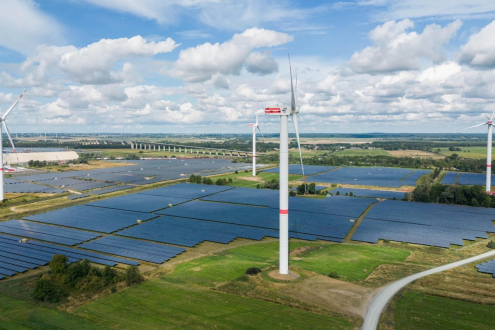
Мongolia has pledged before the international community to generate 30 percent of its domestic energy from renewable sources by 2030. In this context, Energy Sight magazine has consistently covered the government’s concrete steps to attract foreign investment and increase private sector involvement. In this edition, we highlight the importance of infrastructure development and construction activities that accompany renewable energy projects in Mongolia. Over the past decade, favorable conditions have emerged for the implementation of numerous renewable energy projects in our country, leading to the rise of solar panels and wind turbines.
However, the underdeveloped state of infrastructure, both locally and regionally, posed significant challenges to project implementation. Just imagine transporting a single wind turbine blade-large enough to require an entire freight train car-to a project site. Along with such logistical challenges came issues like outdated or decommissioned substations, grid lines, and equipment across provinces and soums-a reality well acknowledged in the sector. As a result, implementing renewable energy projects often required comprehensive planning and significant investment from the ground up.
Renewable energy projects in rural and regional areas are doing more than just turning on the lights they are serving as key drivers of improved quality of life, infrastructure modernization, and technological advancement.
For example, the construction of new roads facilitates easier transport between soums, and improved internet connectivity enhances access to information, education, and services. Most importantly, advanced technologies are being localized in Mongolia. Such multifaceted infrastructure investments not only support the goal of independent energy production but are also becoming prerequisites and guiding factors for the development of other sectors.
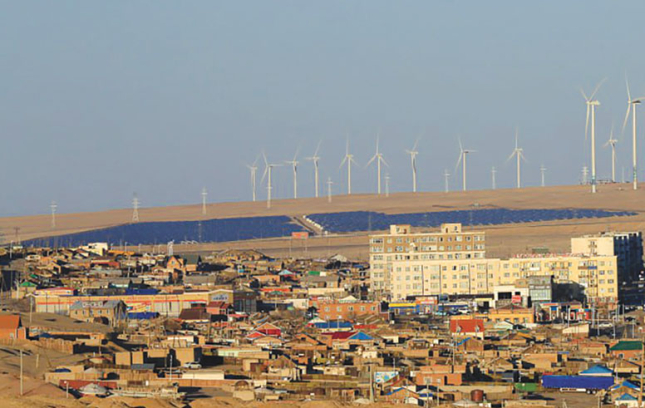
According to 2024 statistics from the Energy Regulatory Commission, Mongolia currently operates 10 solar power plants with a total capacity of 181.8 MW and 3 wind power plants with a capacity of 155 MW.
These projects have attracted a total investment of USD 533 million, of which USD 364 million has been allocated to wind energy projects and USD 169 million to solar energy projects. For instance, the Sainshand Wind Power Plant supplies reliable electricity to more than 100,000 consumers in Mongolia’s southeastern region, particularly along the Choir–Airag–Sainshand Zamyn-Uud corridor. It also helps reduce the load on other substations in the region. Additionally, the project utilizes 12.1 hectares of land for telecommunications infrastructure and 9.9 hectares for paved road construction. Furthermore, it has had a positive impact by attracting USD 117.5 million in foreign direct investment into Mongolia.
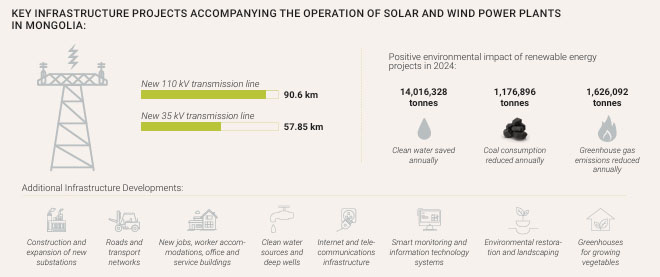
The Erdene Solar Power Plant conducted a pilot project-unprecedented in Mongolia and, by some technical criteria, a global first-under the supervision of the National Dispatching Center. Specifically, the experiment successfully supplied electricity to Zamyn-Uud soum from a battery storage system via a 15-km-long 110 kV transmission line, independent of the National Grid. As a result, this became the first renewable energy source in Mongolia to integrate such advanced technology. The Gobi Solar Power Plant was the first in Mongolia to implement an Active Network Management Control System, which allows for monitoring the load of the 110 kV overhead transmission line running along the Choir–Airag Sainshand route. Moreover, the plant introduced 110,880 solar panels from the globally leading Trina Solar brand (model TSM-PD05, 270 W capacity) and 10 SG2500 inverters from Sungrow, a company ranked number one worldwide for the fifth consecutive time by BloombergNEF. These are globally recognized components in the solar energy sector and are known for their reliability. The Tsetsii Wind Power Plant completed the assembly and installation of 25 wind turbines, as well as the construction of a 32-km overhead power transmission line to connect its substation to Mongolia’s Central Energy System. During the construction phase, the project provided employment for approximately 500 people. In addition, it contributed to the development of national and local road and railway infrastructure. Beyond this, a new generation of local engineers is being trained to master advanced technologies of solar and wind energy systems, with many preparing to work at the plant's control center. This is playing a key role in building the future capacity of Mongolia’s domestic workforce.
All these developments bring real benefits beyond simply increasing the energy supply-such as job creation, income generation, economic revitalization of provinces and soums, and increased settlement stability in rural areas. A large portion of Mongolia’s territory remains beyond the reach of the central power grid, making regional development disparities a persistent issue. Therefore, renewable energy projects should not only be seen as sources of clean energy but also as key drivers of local development that require strong policy support. This calls for urgent updates to relevant laws, regulations, and investment mechanisms. Fully recognizing this opportunity at the policy level and utilizing it comprehensively to promote sustainable development, energy independence, and social equity is one of the most important strategic decisions of this century.

 277
2025-06-19
277
2025-06-19